Search
Disclaimer

Clicking the images or links will redirect you to a website hosted by BenchSci that provides third-party scientific content. Neither the content nor the BenchSci technology and processes for selection have been evaluated by us; we are providing them as-is and without warranty of any kind, including for use or application of the Thermo Fisher Scientific products presented.
Invitrogen
Urokinase Monoclonal Antibody (U-12)
{{$productOrderCtrl.translations['antibody.pdp.commerceCard.promotion.promotions']}}
{{$productOrderCtrl.translations['antibody.pdp.commerceCard.promotion.viewpromo']}}
{{$productOrderCtrl.translations['antibody.pdp.commerceCard.promotion.promocode']}}: {{promo.promoCode}} {{promo.promoTitle}} {{promo.promoDescription}}. {{$productOrderCtrl.translations['antibody.pdp.commerceCard.promotion.learnmore']}}
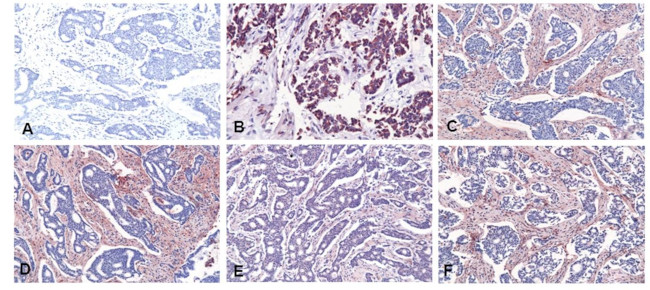
图: 1 / 1
Urokinase Antibody (MON U-12-02) in IHC
Immunohistochemistry was performed on human primary invasive breast cancer tissue sections. Following tissue processing using a formalin-free, HEPES-glutamic acid buffer-mediated organic solvent protection effect fixation technique, tissues were blocked with 3% hydrogen peroxide for 10 minutes at room temperature. Tissues were probed with buffer alone as a negative control (panel A), a positive control Urokinase Plasminogen Activator monoclonal antibody, clone SPM457 (panel B), or Urokinase Plasminogen Activator monoclonal antibodies, Prod... View More

产品信息
MON U-12-02
应用
建议稀释比
已发表文章
产品规格
宿主/亚型
Mouse
/ IgG1
分类
Monoclonal
类型
Antibody
克隆号
U-12
抗原
Native human uPA.
偶联物
形式
Liquid
浓度
1 mg/mL
保存条件
4°C, store in dark, DO NOT FREEZE!
运输条件
Wet ice
RRID
产品详细信息
MON U-12-02 is specific for human uPA. No reaction with human tissue plasminogen activator (tPA) is seen when tested by ELISA, immunoblotting and enzyme inhibition. No reaction with any other human plasma proteins is seen when tested by immunoblotting.
MON U-12-02 has successfully been used in ELISA, Western blot and immunohistochemistry (frozen) applications.
The immunogen used to produce MON U-12-02 is native human uPA.
NOTE: Concentration is lot-dependent and can vary from 0.85-1.15 mg/mL
靶标信息
This gene encodes a serine protease involved in degradation of the extracellular matrix and possibly tumor cell migration and proliferation. A specific polymorphism in this gene may be associated with late-onset Alzheimer's disease and also with decreased affinity for fibrin-binding. This protein converts plasminogen to plasmin by specific cleavage of an Arg-Val bond in plasminogen. Plasmin in turn cleaves this protein at a Lys-Ile bond to form a two-chain derivative in which a single disulfide bond connects the amino-terminal A-chain to the catalytically active, carboxy-terminal B-chain. This two-chain derivative is also called HMW-uPA (high molecular weight uPA). HMW-uPA can be further processed into LMW-uPA (low molecular weight uPA) by cleavage of chain A into a short chain A (A1) and an amino-terminal fragment. LMW-uPA is proteolytically active but does not bind to the uPA receptor. Alternatively spliced transcript variants encoding different isoforms have been found for this gene.
仅用于科研。不用于诊断过程。未经明确授权不得转售。
篇参考文献 (0)
您是否在文献中引用过该产品?请点击下方按钮邮件告知我们。

